
On this page
Overview
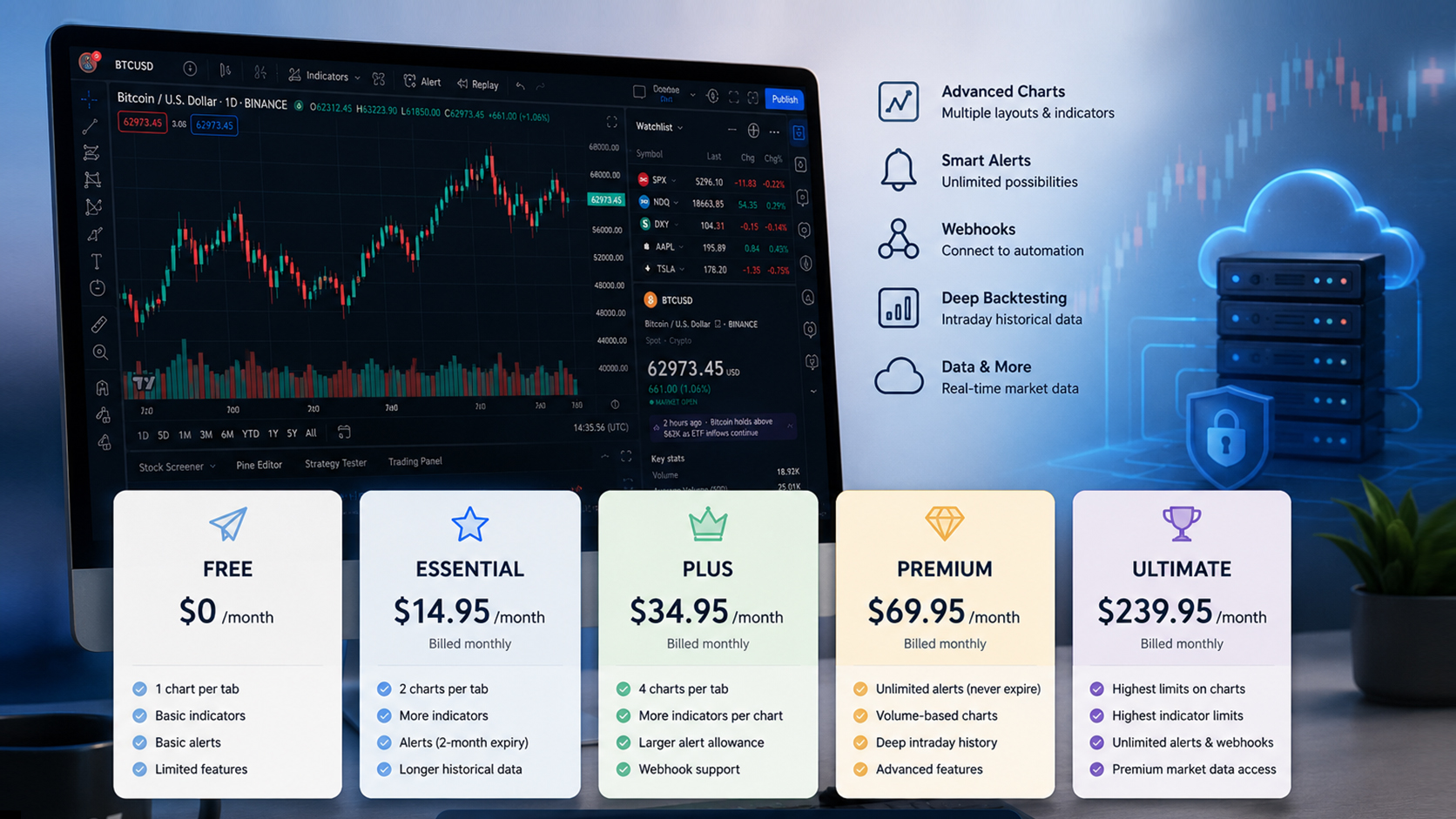
TradingView runs a free tier plus four paid subscriptions, and pricing depends heavily on whether you pay monthly or commit to a year upfront. TradingView raised prices across every paid tier in April 2026 by roughly 17 to 20 percent, so figures floating around from before then are out of date. Here is where things stand now.
Current TradingView pricing

Free: $0. One chart per tab, a handful of indicators, and basic alerts. Fine for casual chart reading, tight for anything more.
Essential: $14.95 per month billed monthly, or roughly $12.95 per month billed annually. The first real upgrade, adding more charts, more indicators per chart, and longer historical data.
Plus: $34.95 per month billed monthly, or roughly $29.95 per month billed annually. Adds four charts per tab, a much larger alert allowance, and webhook support for connecting alerts to automation.
Premium: $69.95 per month billed monthly, or roughly $59.95 per month billed annually. Adds alerts that never expire (Essential alerts expire after two months), volume-based chart types, and deeper intraday history for backtesting.
Ultimate: $239.95 per month billed monthly, or roughly $199.95 per month billed annually. Built for professional and institutional users, with the highest chart, indicator, and alert limits and access to paid professional market data feeds.
The free trial
Essential, Plus, and Premium all come with a 30-day free trial, and Ultimate offers 14 days. TradingView also runs seasonal sales, most notably around Black Friday and Easter, where annual plans have historically dropped 40 to 80 percent off list price, so it is worth timing an annual commitment around one of those windows rather than paying full price the day you decide to upgrade.
The real cost is more than the subscription

The plan price only covers the platform itself. Real-time data for many exchanges, especially futures venues like CME, is billed separately as an add-on subscription, and this is where costs can jump unexpectedly. A trader following live futures prices might pay under $15 a month for CME data on a lower TradingView tier, but the moment TradingView classifies an account as "professional" (generally triggered by trading for an employer or managing outside capital), the same data feed can jump to several hundred dollars a month. It's worth checking your account's professional/non-professional status if your subscription cost suddenly changes.
Which plan actually fits

Most traders overpay for capacity they never use. If you are running two or three indicators on a single chart with a modest watchlist, Essential covers that comfortably. Plus is the natural upgrade once you are running multiple layouts at once or need webhook alerts to trigger automation.
Premium mainly earns its price for traders who rely on alerts that must stay active indefinitely or who need deep intraday history for serious backtesting. Ultimate is overkill unless you are a professional managing several strategies across markets, or your employer is footing the bill.
One thing TradingView doesn't do
TradingView is a charting and analysis platform, not a broker, and a subscription alone does not execute trades. You still connect a separate broker account, or run MetaTrader, NinjaTrader, or another execution platform alongside it. If your actual trading happens on MT4, MT5, or NinjaTrader, that platform needs to stay online and connected independently of whatever you are paying TradingView, which is exactly what a dedicated trading VPS is for.
Pair Your Charts With a Platform That Never Sleeps
TradingView shows you the opportunity; your execution platform is what actually acts on it. PropVPS keeps MT4, MT5, NinjaTrader, or cTrader running 24/5 on a Windows VPS with sub-1ms execution to major exchanges, so the alert you set in TradingView has somewhere reliable to land.
See supported trading platforms: https://propvps.com/platforms